College Campus Resources for Compassionate Dialogue
#CampusBridge has developed two videos with accompanying checklists and a facilitation guide for colleges and universities to share with students to promote dialogue and understanding on campus.

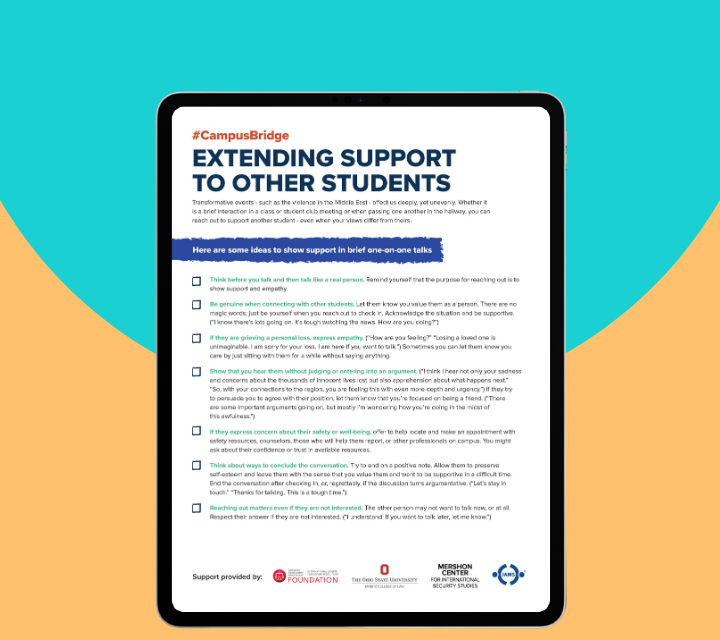
Are you a campus leader seeking materials to hold one- to two-hour workshops for students during new student orientation or through their residence hall? As a result of a grant from the AAA-ICDR Foundation, the Divided Community Project at the Ohio State University Moritz College of Law offers colleges and universities two videos with accompanying checklists and a facilitation guide without charge.
"Reaching Out Matters" illustrates in five minutes a student extending support to her friends, a relatable approach for students of using the checklist that is posted at go.osu.edu/dcpexs. Students can learn simple techniques that help them offer this support to friends while avoiding being drawn into unwanted arguments.
"A Difficult Conversation Among Friends" shows twenty minutes of a tough but supportive conversation between two friends who have deeply rooted differences about the Middle East conflict. The video can be paired with any "difficult conversations" checklist; one is included in the Facilitator’s Guide for #CampusBridge Videos. This video is recommended for use among staff or students whose emotions permit them to listen with compassion to other viewpoints.
All of these resources are available by emailing Bill Froehlich, Director of the Divided Community Project, at Froehlich.28@osu.edu. Other resources for campus leaders, including a booklet, Leading a Divided Campus: Ideas and Illustrations, can be downloaded from go.osu.edu/campusbridge.